Four Domains of Change (Application)
To support meaningful change, the model maps each principle onto four domains of curriculum design and delivery, helping educators consider where and how to embed inclusive practices.
Content
What students are engaging with—including lectures, tutorials, readings, case studies, datasets, and other examples.
Pedagogic Interaction
How students and educators interact in the learning space—including classroom dynamics, facilitation, discussion norms, and student support.
Assessment
How learning is evaluated—including task design, feedback practices, grading criteria, and other opportunities for students to demonstrate learning.
Learning Journey
How the module is structured and scaffolded to align with learning outcomes—including what students learn, when, how, and in what sequence.
Grid Format
The five principles of practice and four domains of change come together in a 5x4 grid, shown below. Each box represents a potential starting point for decolonising and diversifying the curriculum. You can start exploring these boxes using the Interactive Tool.
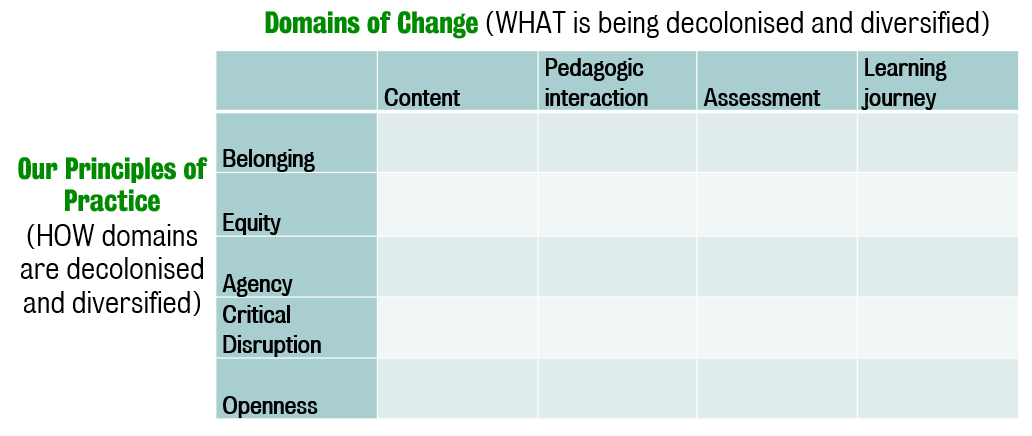
The BEACON model is not intended to be prescriptive. Educators are not expected to engage with every box; instead, the model encourages small, meaningful steps that align with an educator’s interests, capacity, and module context. We recognise that decolonising and diversifying the curriculum is an ongoing process, not a checklist—but every journey has to start somewhere. These boxes are designed as accessible entry points, or continuation points for those already on the path. We hope all KBS educators will engage with the model in some way and continue to build on that engagement over time.
We recognise that some overlap exists between the boxes, and this is intentional. The BEACON model is designed as a practical framework rather than a strict theoretical map, and some principles will naturally intersect or contrast within and across domains and teaching activities. These areas of overlap are intended to offer flexibility, reinforce connections, and support an integrated approach to teaching re-design, rather than to create confusion.